



Staircase renovation has historically occupied an awkward position in the flooring trade — a high-visibility project that clients want addressed as part of a broader hardwood flooring installation, but one that traditional full replacement approaches made time-consuming, disruptive, and expensive enough to slow the sales conversation before it properly started. The emergence of retrofit stair treads as a purpose-engineered solution has fundamentally changed that dynamic, and flooring dealers, remodeling contractors, and stair installers who have incorporated them into their standard offering are finding the category delivers margin, client satisfaction, and project efficiency that conventional stair replacement approaches cannot match.
The Problem Retrofit Treads Were Designed to Solve
Traditional stair renovation through full tread replacement requires the removal of existing treads — a process that frequently involves cutting fasteners, managing adhesive bonds, and navigating the structural variables of the underlying stair carriage without compromising its integrity. On older staircases, this process introduces a range of unpredictable complications: damaged risers exposed during removal, subfloor conditions that require remediation before new treads can be installed, and structural irregularities that add time and cost to what clients typically envision as a straightforward update.
For residential clients undertaking a hardwood flooring installation throughout their home, the expectation is that the staircase will be addressed as part of the same project — matching species, finish, and visual character to the new floor throughout. Full tread replacement delivers that outcome but at a cost in time, disruption, and project complexity that frequently creates friction in the client conversation and compresses the margin available to the installing contractor.
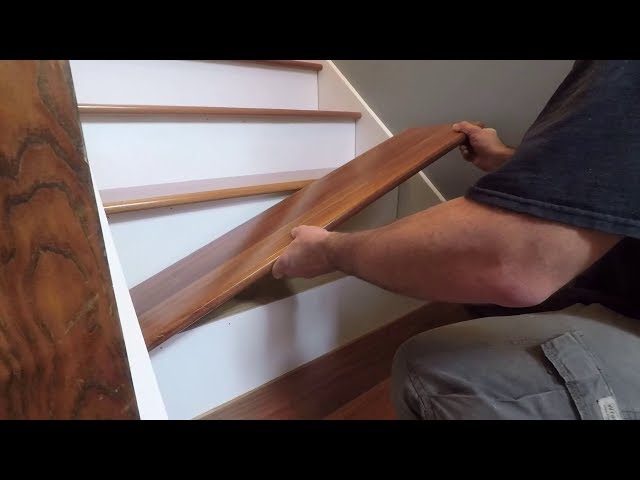
Retrofit stair treads address this problem directly. Engineered to overlay the existing tread surface rather than replace it, they eliminate the removal process entirely — along with its associated complications, time requirements, and structural risks. The result is a staircase renovation pathway that is faster to install, more predictable in its cost structure, and significantly less disruptive to the client’s home during the project period.
Why the Category Matters to Flooring Dealers
For flooring retailers and dealers, retrofit stair treads represent an opportunity to complete the hardwood flooring sale in a way that full-replacement stair renovation frequently prevents. When a client is investing in new hardwood throughout the main living areas of their home, the staircase is the visual centrepiece that connects those floors — and a staircase left with dated carpet or mismatched wood undermines the cohesion of the entire installation from the moment it is completed.
The conversation around stair renovation tends to stall when the complexity and cost of full replacement are introduced. Retrofit treads lower that threshold meaningfully, making it practical to include the staircase in the same project scope and the same client budget conversation without the complications that full replacement introduces. For dealers operating in competitive residential flooring markets, the ability to offer a complete hardwood solution — floor and stair — in a single transaction is a genuine differentiator.
Prefinished retrofit treads eliminate the finishing trade from the project equation entirely. Factory-applied finishes on quality retrofit treads are engineered to match the finish profiles of prefinished hardwood flooring products, ensuring visual consistency between the staircase and the surrounding floor without the scheduling, ventilation, and drying time requirements of site-finishing. For dealers whose client base values project speed and minimal household disruption, this is a specification advantage worth communicating clearly in the sales process.
Installation Efficiency That Contractors Value
For remodeling contractors and stair installers, the operational case for retrofit treads is built around installation speed and project predictability. A retrofit tread installation on a standard residential staircase can be completed in a fraction of the time required for full tread replacement — with a scope of work that is defined and predictable from the outset rather than subject to the structural discoveries that removal frequently introduces.
The installation process for retrofit treads involves surface preparation of the existing tread — cleaning, securing any movement, and ensuring a flat bonding surface — followed by adhesive application and placement of the overlay tread. On straightforward installations, the process is well within the skill set of an experienced flooring installer without specialist stair carpentry knowledge, which expands the installer base available to contractors managing multiple simultaneous projects.
Accurate measurement is the critical skill the retrofit installation demands. Existing treads are rarely dimensionally consistent across a full flight — width, depth, and nosing profile vary enough between treads and between staircases that precise measurement and appropriate product selection for each individual tread are prerequisites for a clean finished result. Contractors who develop a reliable measurement and specification workflow for retrofit installations create the repeatability that makes the category genuinely efficient at scale.
Matching Species and Finish to the Surrounding Floor
The visual integration of the staircase with the surrounding hardwood floor is the outcome that clients care about most — and the specification decision that most directly determines whether a retrofit installation achieves the seamless result that justifies the investment.
Species matching is the foundational requirement. Retrofit treads available in the same hardwood species as the surrounding floor — red oak, white oak, maple, hickory, and the range of domestic and select exotic species that premium residential flooring projects involve — allow visual consistency that carpet-to-wood conversions and species mismatches cannot achieve. For architects and interior designers specifying stair treads as part of a comprehensive hardwood interior, species and grade consistency across floor and stair is a non-negotiable design standard.
Finish matching requires equal attention. Prefinished retrofit treads are available across the stain and sheen profiles that contemporary residential flooring preferences demand — from raw and natural wire-brushed white oak finishes that dominate current design trends to the warmer toned and hand-scraped profiles that remain prevalent in traditional and transitional interior styles. Specifying a retrofit tread finish that aligns with the prefinished flooring product already selected for the project is the detail that separates a fully resolved installation from one that reads as an afterthought.
Wood Stair Co supplies prefinished hardwood retrofit stair treads to flooring dealers, remodeling contractors, homebuilders, and design professionals — with a species and finish range built around the specification requirements of premium residential stair renovation and the operational needs of trade professionals who require consistent quality and reliable availability across project schedules.
