



For many bystanders and even some trained rescuers, one of the most confusing aspects of choking emergencies is the abrupt shift in technique once a person loses consciousness. Understanding how does CPR differ in an unresponsive adult choking victim starts with understanding why this shift happens at all, since the reasoning behind the protocol makes the steps far easier to remember and execute correctly under pressure.
While a person remains conscious and choking, abdominal thrusts work by creating a sudden burst of upward pressure beneath the diaphragm, forcing air out of the lungs in a way that can dislodge an object blocking the airway. This technique depends on the person’s own diaphragm and abdominal muscles cooperating with the thrust, along with a rescuer positioned behind them to deliver it correctly. Once a person becomes unresponsive, this cooperation is no longer possible. Muscle tone changes, positioning behind the victim is no longer practical since they need to be lowered to the ground, and abdominal thrusts simply stop being an effective or safe option.
This is precisely why chest compressions replace abdominal thrusts as soon as unresponsiveness occurs. Chest compressions serve two purposes simultaneously in this scenario, something that does not apply during standard cardiac arrest CPR. First, they maintain circulation, keeping oxygenated blood moving to the brain and vital organs, which is the same core purpose compressions serve in any CPR scenario. Second, in a choking emergency specifically, the pressure generated by compressions can help dislodge the object obstructing the airway, functioning somewhat similarly to the pressure created by abdominal thrusts but through a different mechanical pathway. This dual purpose is why compressions become the immediate priority the moment a choking victim loses consciousness, rather than continuing to attempt thrusts.
The mouth check that occurs before each set of rescue breaths exists for a related reason. Since compressions may have helped move the obstruction, checking for a visible object before attempting to deliver breaths allows the rescuer to remove it if it has become reachable, potentially clearing the airway enough for breaths to be effective. This is different from standard CPR, where no obstruction is assumed to exist and no repeated visual check is built into the compression and breath cycle. Understanding this distinction helps explain why the two protocols, though similar in physical technique, differ in this specific procedural detail.
The prohibition against blind finger sweeps also becomes clearer with this reasoning in mind. Because the airway is already compromised, introducing a finger without being able to see the object risks pushing it further down the throat, potentially converting a partial obstruction into a complete one or making the blockage more difficult to reach for emergency responders arriving afterward. Only visible, easily reachable objects should be removed, a rule rooted in minimizing additional harm rather than an arbitrary restriction.
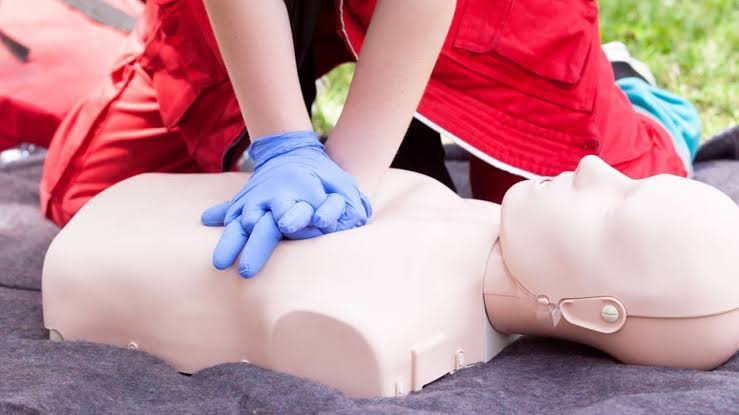
The compression technique itself, hands centered on the chest, compressions delivered hard and fast at a depth of at least two inches and a rate of 100 to 120 per minute, remains consistent with standard adult CPR because the underlying physiology of circulation does not change based on the cause of unresponsiveness. What changes is the added objective of using that same mechanical force to potentially resolve the airway obstruction at the same time.
Rescuers should continue this cycle without stopping prematurely, since an early pause based on assumption rather than confirmed recovery can significantly reduce the chances of a positive outcome. The cycle continues until the person regains consciousness and breathes effectively on their own, an AED becomes available, or trained emergency personnel arrive to take over.
Understanding the reasoning behind each step, not just memorizing the sequence, is what allows healthcare professionals, childcare workers, fitness professionals, and caregivers to respond with confidence rather than hesitation during a real emergency. Reading through the physiology and rationale is a strong starting point, but hands-on certification training remains essential for building the muscle memory needed to act correctly under pressure. Those ready to build or renew this critical skill set can find structured, up-to-date training through Simple CPR, designed to prepare healthcare professionals, caregivers, and the general public to respond effectively when seconds matter most.
