



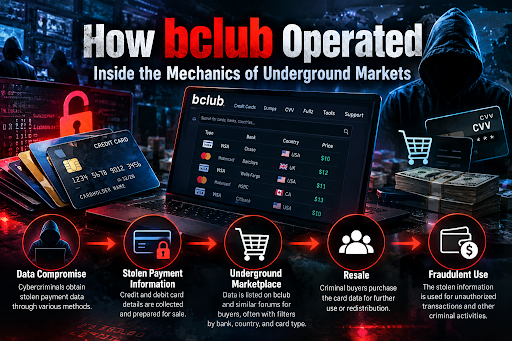
The story of bclub, more commonly discussed as briansclub or Brians Club, offers an unusually detailed look at how underground markets can turn stolen information into a commercial product.
At first glance, an illicit card marketplace might seem simple: stolen payment information goes in, buyers purchase it, and criminals attempt to profit. The reality is considerably more complicated.
BriansClub operated within a broader ecosystem involving data theft, aggregation, classification, marketplace management, buyers, sellers, payment systems, and fraud. Researchers studying bclub leaked marketplace records were able to reconstruct important aspects of that ecosystem and demonstrate that it behaved in surprisingly recognizable economic ways.
The findings also revealed something that is easy to miss when focusing only on headlines about millions of stolen cards: not all stolen information had the same value, and much of the inventory never sold at all.
Understanding that distinction is essential for anyone studying cybersecurity, financial crime, or the underground economy.
What Was bclub?
BriansClub was an underground marketplace associated with stolen credit- and debit-card information.
The marketplace emerged during a period when criminal groups were increasingly specializing in different stages of the cybercrime process. Rather than every participant carrying out an attack from beginning to end, different actors could focus on obtaining data, aggregating it, selling it, or attempting to monetize it.
This specialization helped create a marketplace model.
Research conducted by New York University’s Tandon School of Engineering examined data associated with BriansClub covering activity from 2015 through 2019. The researchers identified more than 19 million unique card numbers listed during the period studied and estimated approximately $104 million in gross revenue.
Those figures make bclub useful as a case study because they provide evidence of an underground market functioning at substantial scale.
The Basic Mechanics of an Underground Marketplace
The simplest way to understand the BriansClub ecosystem is to separate it into several layers.
1. Data acquisition
Payment information could originate from compromised businesses, malicious software, payment-system intrusions, or other forms of theft.
The marketplace itself was therefore not necessarily the location where the original compromise occurred.
2. Data aggregation
Information obtained from different sources could be collected and organized.
Aggregation creates economies of scale: instead of dealing with individual stolen records separately, an underground marketplace can present a large inventory to potential buyers.
3. Classification
Information was not necessarily treated as one undifferentiated database.
Records could have characteristics that influenced their perceived usefulness, including transaction type, issuing institution, geographic factors, and other attributes.
4. Marketplace distribution
The marketplace provided an environment where buyers could browse available inventory and select information they considered useful.
5. Monetization
The final objective was financial.
Criminal buyers attempted to turn acquired information into fraudulent transactions or other illicit activity.
This separation of roles is one of the most important characteristics of modern cybercrime ecosystems.
Briansclub Was a Marketplace, Not Simply a Data Breach
It is tempting to describe every large cybercrime incident as a “breach,” but the terminology matters.
A data breach generally refers to unauthorized access to or exposure of information.
A marketplace is where information obtained through various means can subsequently be offered for sale.
The distinction becomes particularly important when discussing briansclub.
In 2019, a hacker breached BriansClub itself and extracted more than 26 million credit- and debit-card records. The information was later shared with KrebsOnSecurity and researchers studying payment-card fraud.
In other words, there were two different layers of compromise worth distinguishing:
- The original thefts that supplied information to the marketplace
- The later intrusion that exposed the marketplace’s own database
That second event effectively turned an underground market into a source of research data.
How Supply and Demand Worked
One of the most revealing discoveries about bclub was that its inventory did not behave like a guaranteed-sales catalog.
The NYU research found that more than 19 million unique card numbers were listed between 2015 and 2019. Yet approximately 60% of the accounts did not find buyers.
That is a striking finding.
A stolen card record might exist in a marketplace database without ever generating revenue.
Why?
Because criminal buyers, like legitimate consumers, make choices.
The perceived usefulness of information could depend on factors such as:
- Whether the information was recent
- Whether it remained usable
- The type of transaction associated with it
- Issuing-bank characteristics
- Geographic considerations
- Existing fraud controls
- The perceived likelihood of a transaction being blocked
This created a marketplace in which quantity and quality were very different measurements.
A marketplace could contain millions of records while only a smaller subset attracted meaningful demand.
Inventory Was Not the Same as Revenue
This distinction is crucial when interpreting reports about underground markets.
A headline might say that millions of cards were “available.”
That does not mean millions were purchased.
The NYU study estimated approximately $103.9 million in gross revenue from the marketplace during the period examined, despite a much larger volume of listed inventory.
Researchers also estimated approximately $24 million in profit.
The difference between inventory, sales, revenue, and profit is important.
A marketplace can list a huge amount of material without successfully monetizing all of it.
That is true of legitimate commerce, too. Unsold inventory still exists, but it does not generate revenue simply because it is listed.
What Types of Information Attracted Demand?
The research also showed that buyers did not treat all payment information equally.
Approximately 97% of BriansClub’s inventory consisted of magnetic-stripe data. Customers purchased only around 40% of that inventory. Meanwhile, researchers found substantially stronger demand for card-not-present information, with roughly 83% of that inventory being sold.
This difference demonstrates how technological changes affect underground markets.
When legitimate payment systems become more secure, criminals may shift their attention toward information that remains useful under the new environment.
The market therefore changes alongside the defensive technology.
The Impact of EMV
The adoption of EMV chip cards provides a particularly useful example.
EMV technology made certain forms of counterfeit card fraud more difficult. But the BriansClub data demonstrated that EMV adoption did not make stolen payment information irrelevant.
During the final two years represented in the leaked dataset, researchers found that 85% of stolen magnetic-stripe data originated from cards that were EMV chip-enabled.
The important lesson is not that EMV “failed.”
Rather, it shows that security technologies protect specific parts of a transaction ecosystem.
A stronger physical-card authentication mechanism does not automatically eliminate every method of obtaining or abusing payment information.
That is why payment security requires multiple layers.
The Business Structure Behind bclub
Although BriansClub was an illegal enterprise, its marketplace characteristics had recognizable business-like features.
Researchers identified distinct groups of sellers and buyers and were able to analyze transaction activity over several years.
The underlying structure included concepts familiar from legitimate marketplaces:
Sellers
Participants supplied stolen payment information.
Buyers
Other participants sought information they believed could be monetized.
Inventory
The marketplace maintained a large collection of records available for potential purchase.
Pricing
Different categories of information had different perceived values.
Transactions
Purchases generated measurable revenue.
Customer demand
Some categories sold substantially faster than others.
Unsold stock
A large proportion of inventory remained without buyers.
This does not make the operation legitimate. It demonstrates something else: criminal markets can adopt familiar economic structures while operating outside the law.
Why Specialization Made the Ecosystem Powerful
One person does not necessarily need to perform every stage of a cybercrime operation.
A specialized ecosystem can divide responsibilities.
For example, one group may focus on compromising systems, another on collecting information, another on aggregating data, and another on attempting to monetize it.
This division can lower the technical burden on individual participants.
It also creates a form of resilience.
If one component disappears, other participants may continue operating through different channels.
That is why cybersecurity investigators often look beyond individual websites and examine the broader infrastructure, financial relationships, and criminal services surrounding them.
The 2019 Breach Changed What Researchers Could See
The 2019 compromise of BriansClub was unusual because the marketplace itself became the victim of a data breach.
More than 26 million records were reportedly extracted.
Once researchers obtained the information, they could analyze activity that would normally remain hidden.
The NYU team could investigate:
- How much inventory existed
- How much information was sold
- Which categories attracted demand
- How many participants were involved
- How revenue accumulated
- How payment technology affected demand
- How much inventory remained unsold
The research consequently moved discussion of underground card markets away from speculation and toward measurable evidence.
What the Researchers Discovered About Market Efficiency
Perhaps the most surprising finding was how inefficient the marketplace could be.
If roughly 60% of listed accounts failed to attract buyers, then the market was carrying a huge amount of inventory that did not produce a sale.
That finding matters because it changes how we should interpret the size of underground markets.
A criminal marketplace may advertise millions of records.
But the more meaningful questions are:
How many records are valid?
How many remain useful?
How many are actually purchased?
How much revenue is generated?
How long does the information retain value?
Those questions provide a much better picture of the real economic impact.
What Happened When Technology Changed?
The BriansClub research provides a useful example of the constant interaction between attackers and defenders.
When payment technology changes, criminal markets adapt.
When fraud controls improve, some stolen information becomes less attractive.
When one category becomes difficult to monetize, demand can shift toward another.
This produces a continuing cycle:
Security improvement → reduced usefulness → changing criminal demand → adaptation → new defensive response
The cycle is not unique to payment cards. Similar patterns appear throughout cybersecurity.
Attackers respond to authentication improvements.
Defenders respond to new attack methods.
Criminal marketplaces adjust to technological changes.
Security teams then develop additional controls.
The BriansClub case makes this dynamic unusually visible because researchers had access to historical marketplace data.
Why bclub Still Matters to Cybersecurity
It would be easy to treat BriansClub as an outdated criminal marketplace and move on.
That would miss the larger lesson.
The case demonstrates several principles that remain relevant.
Stolen information has a lifecycle
Data is not necessarily valuable forever.
Its usefulness can decline when accounts are closed, credentials are changed, payment cards are replaced, or fraud systems identify suspicious activity.
Criminal markets depend on demand
The existence of stolen information does not guarantee successful monetization.
BriansClub’s large quantity of unsold inventory demonstrates that clearly.
Defensive technology can change criminal economics
Security controls can make certain categories of stolen information less useful.
That means cybersecurity has an economic effect, not just a technical one.
A marketplace can reveal more than an individual breach
Studying a criminal marketplace can expose relationships between multiple incidents and show how stolen information moves through an ecosystem.
Lessons for Businesses
The mechanics of BriansClub offer several practical lessons for organizations handling payment information.
Protect the entire payment environment
Do not focus exclusively on databases.
Consider point-of-sale systems, APIs, third-party providers, employee credentials, endpoints, networks, and administrative interfaces.
Limit access
Sensitive information should not be broadly accessible to systems or employees that do not require it.
Monitor continuously
Unusual access patterns can provide early warning of compromise.
Minimize stored data
Information that does not need to be retained generally does not need to be protected indefinitely.
Prepare for the aftermath
Incident response should address not only how attackers entered but also what information they may have accessed and how quickly affected customers can be protected.
What Consumers Can Learn From Brians Club
Consumers cannot control the security practices of every retailer or payment provider they use.
They can, however, reduce the consequences of suspicious activity.
Useful habits include:
- Reviewing account activity regularly
- Enabling transaction notifications
- Reporting unauthorized transactions quickly
- Taking breach notifications seriously
- Using unique passwords for important accounts
- Keeping devices and software updated
- Avoiding unnecessary disclosure of financial information
The objective is not to assume that every online service is dangerous.
It is to recognize that a compromise can happen outside your direct control.
Separating Historical Research From Current Claims
Searches for bclub, briansclub, and brians club can produce a mixture of cybersecurity reporting, historical material, forum discussions, and unsupported claims.
Readers should be particularly careful with pages that blur historical research and claims about current underground services.
A credible source should make it possible to determine:
- When the information was published
- Whether the material is reporting or research
- Whether claims are supported by evidence
- Whether the discussion concerns historical or current events
- Whether the source has a recognized cybersecurity or academic background
That distinction matters because an article discussing BriansClub’s historical operation does not establish that an associated service is currently active.
The Bigger Picture: Underground Markets Are Ecosystems
The most useful way to understand bclub is to stop thinking about it as simply a website containing stolen cards.
It was part of an ecosystem.
Information could originate from one compromised organization, pass through intermediaries, appear in an underground marketplace, attract a buyer, and potentially be used in fraudulent activity.
Each stage creates opportunities for defenders.
A company can strengthen its perimeter.
A payment processor can improve monitoring.
A bank can identify suspicious transactions.
A consumer can report unauthorized activity.
A marketplace can lose inventory.
The overall effectiveness of the criminal ecosystem depends on all of these stages working sufficiently well for attackers.
Interrupting even one stage can increase the cost and reduce the potential return.
Final Takeaway
The mechanics of bclub, briansclub, and brians club reveal a surprisingly structured underground economy.
The marketplace accumulated enormous quantities of stolen payment information, categorized that information, exposed it to potential buyers, and generated substantial revenue. Yet the research also showed that the market was far from perfectly efficient: approximately 60% of listed accounts did not find buyers, while demand varied significantly according to the type and characteristics of the information.
The 2019 breach made those dynamics visible.
Researchers gained access to data that would ordinarily have remained hidden and used it to study the relationship between supply, demand, payment technology, and criminal monetization. Their findings showed that stolen information is not a uniform commodity. Its value changes with technology, security controls, freshness, and buyer demand.
For cybersecurity professionals, that is perhaps the most useful lesson.
Stopping data theft is the first objective. Making stolen information difficult to use, difficult to monetize, and short-lived is the next.
The BriansClub case demonstrates why effective cybersecurity is not simply about building a taller wall around sensitive information. It is about making the entire ecosystem—from initial access to payment processing—less attractive and less profitable for attackers.
