



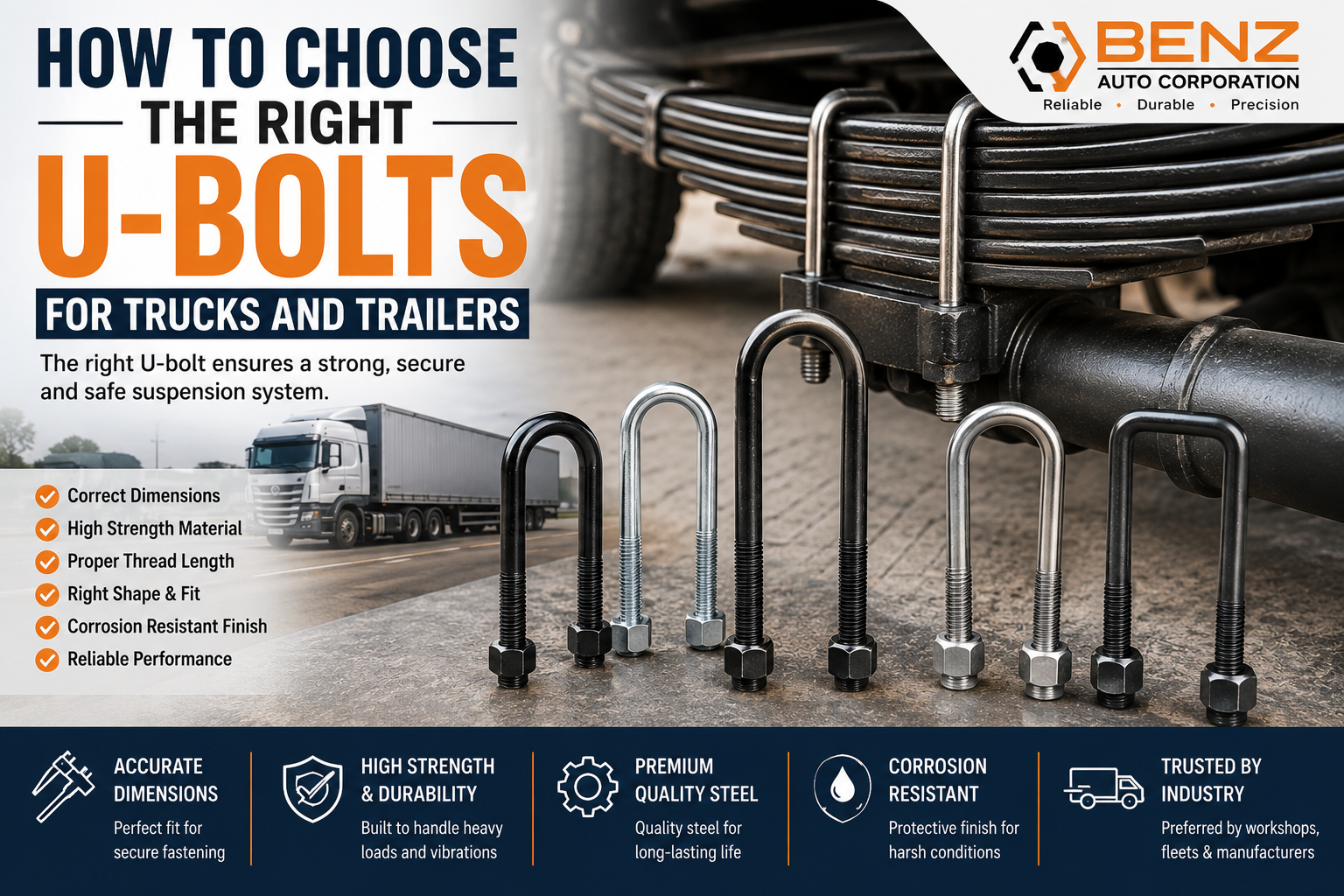
U-bolts are essential components in the suspension systems of trucks, trailers, buses and other commercial vehicles. They secure the leaf spring assembly to the axle and help maintain correct alignment under heavy loads, road vibration and continuous vehicle movement.
Choosing the wrong U-bolt can lead to loose suspension components, uneven load distribution, damaged leaf springs and serious safety risks. Buyers must therefore consider the bolt’s dimensions, material, strength, thread type and application before making a purchase.
This guide explains how to choose the right U-bolts for trucks and trailers and what factors should be checked before installation.
Understand the Role of U-Bolts
In a typical leaf spring suspension system, U-bolts wrap around the axle and pass through a mounting plate. Nuts are tightened on the threaded ends to clamp the axle, leaf spring pack and suspension plate together.
A properly selected U-bolt helps:
- Hold the axle securely in position
- Keep the leaf spring assembly aligned
- Maintain consistent clamping pressure
- Reduce movement between suspension parts
- Support safe load distribution
- Minimise vibration-related loosening
- Improve suspension stability
Because U-bolts operate under high clamping force, they should be treated as safety-critical components rather than ordinary fasteners.
Identify the Correct U-Bolt Shape
The first step is to determine the correct bend shape for the axle or mounting surface.
Round U-Bolts
Round U-bolts have a smooth curved bottom and are generally used with round axles, pipes and cylindrical components.
Square U-Bolts
Square U-bolts have straight sides and a flat bottom. They are commonly used with square sections, flat mounting surfaces and certain trailer assemblies.
Semi-Round U-Bolts
Semi-round U-bolts combine a curved bottom with relatively straight sides. They may be used in specific commercial vehicle suspension designs.
Flat U-Bolts
Flat U-bolts have a wider or flatter bend profile and are suitable for specialised mounting arrangements.
The bend profile must match the axle and spring seat. A poorly matched shape can create uneven contact and reduce clamping efficiency.
Measure the U-Bolt Diameter
The rod diameter is one of the most important measurements because it affects strength, thread size and load capacity.
Measure across the solid rod, not across the threaded portion. Common measuring tools include:
- Vernier caliper
- Micrometre
- U-bolt measuring gauge
A thicker rod generally offers higher strength, but buyers should not increase the diameter without checking the mounting plate holes, nuts and suspension design.
The replacement U-bolt should match the original vehicle specification or the recommendation of a qualified suspension specialist.
Measure the Inside Width
The inside width is the distance between the two inner sides of the U-bolt legs.
This measurement must match the axle diameter or the width of the component being clamped. A U-bolt that is too narrow may not fit, while one that is too wide may move during installation or fail to clamp the assembly correctly.
When measuring an existing U-bolt:
- Place it on a flat surface.
- Measure the clear distance between the inner sides.
- Take the measurement near the straight section of the legs.
- Do not include the rod thickness.
Accurate inside width helps ensure proper fit around the axle.
Measure the Overall Length
U-bolt length is usually measured from the inside of the bend to the end of the threaded leg. However, manufacturers may use slightly different measurement methods, so buyers should clearly confirm the required dimensions.
The U-bolt must be long enough to pass through:
- The axle or axle housing
- The leaf spring pack
- The mounting plate
- Washers
- Nuts
There should be sufficient exposed thread for proper nut engagement, but excessive length should also be avoided because it may interfere with nearby components.
Check the Thread Length
Thread length determines how much adjustment is available during installation.
A U-bolt with insufficient thread length may not tighten correctly on a thick spring pack. Excessively long threading may reduce the smooth shank area and affect how the bolt fits around the axle.
Buyers should consider:
- Leaf spring pack thickness
- Mounting plate thickness
- Washer thickness
- Nut height
- Required thread engagement
The thread length should allow secure tightening without the nut reaching the end of the thread too early.
Confirm the Thread Diameter and Pitch
The thread diameter and pitch must match the nuts being used.
Thread pitch refers to the distance between threads. Depending on the application, the U-bolt may use coarse or fine threads.
Fine threads can provide more precise tightening and greater resistance to loosening in some applications. Coarse threads may be more suitable for dirty or demanding environments because they are generally less sensitive to minor thread damage.
Never force an incorrect nut onto the U-bolt. Mismatched threads can damage both components and reduce clamping strength.
Select the Right Material
U-bolts for trucks and trailers are commonly manufactured from carbon steel, medium-carbon steel or alloy steel.
The correct material depends on:
- Vehicle weight
- Axle load
- Suspension design
- Operating conditions
- Road quality
- Frequency of use
- Corrosion exposure
Heavy commercial vehicles require materials capable of handling higher tensile and fatigue loads. Buyers should ask the manufacturer about the steel grade and mechanical properties rather than judging quality only by appearance.
Check the Strength Grade
U-bolts are exposed to high tension when the nuts are tightened. They also experience repeated stress as the suspension moves.
A suitable strength grade helps prevent:
- Stretching
- Permanent deformation
- Thread failure
- Fatigue cracking
- Sudden breakage
The required strength must match the vehicle manufacturer’s specification. Using a low-strength U-bolt in a heavy-duty truck or trailer can result in premature failure.
At the same time, using a bolt that is unnecessarily hard can create brittleness. The material and heat treatment must be properly balanced.
Consider Heat Treatment Quality
Heat treatment improves the mechanical properties of a U-bolt. It can increase tensile strength, hardness, fatigue resistance and durability.
A reliable manufacturing process should control:
- Heating temperature
- Quenching
- Tempering
- Hardness consistency
- Distortion
- Surface condition
Poor heat treatment may cause the U-bolt to stretch, bend or crack under load. Buyers purchasing in bulk should ask whether the manufacturer performs hardness and strength testing.
Choose the Appropriate Surface Finish
Trucks and trailers operate in conditions involving water, dust, mud, road salt and changing temperatures. A suitable surface finish helps protect the U-bolt from corrosion.
Common finishes include:
- Black finish
- Zinc plating
- Phosphate coating
- Galvanised finish
- Geomet-type coating
- Dacromet-type coating
- Customer-specified protective coatings
The correct finish depends on the operating environment. Vehicles used in coastal, wet or chemically exposed areas may require higher corrosion resistance.
The surface coating must also be considered when applying torque because some coatings affect friction between the threads and nuts.
Match the U-Bolt to the Vehicle Application
Not every U-bolt is suitable for every commercial vehicle.
Before ordering, provide the supplier with:
- Vehicle make and model
- Axle type
- Leaf spring dimensions
- Load capacity
- U-bolt shape
- Rod diameter
- Inside width
- Overall length
- Thread length
- Thread pitch
- Required finish
- Quantity
For older, imported or modified vehicles, an original sample or technical drawing may be necessary.
Check the Leaf Spring Pack Thickness
The thickness of the complete leaf spring pack affects the required U-bolt length.
Leaf spring packs can change if:
- Extra leaves are added
- Worn leaves are replaced
- Heavy-duty springs are installed
- Suspension height is modified
- Helper springs are fitted
Using the original U-bolt length after modifying the spring pack may result in insufficient thread engagement. The complete suspension assembly should therefore be measured again after any modification.
Inspect the Mounting Plate
The U-bolt must fit correctly through the mounting plate holes.
Check:
- Hole diameter
- Hole spacing
- Plate thickness
- Surface condition
- Cracks or deformation
- Nut seating area
An oversized, worn or bent mounting plate can prevent the U-bolt from applying even clamping force.
The plate should be replaced if it is cracked, severely corroded or permanently deformed.
Use the Correct Nuts and Washers
The nuts and washers must match the U-bolt’s diameter, thread pitch and strength grade.
High-quality nuts should:
- Engage smoothly
- Provide full thread contact
- Resist stripping
- Maintain tightening force
- Match the U-bolt strength
Hardened washers may be used where specified to distribute pressure and protect the mounting plate.
Mixing old nuts with new U-bolts is not recommended when the threads are damaged, corroded or stretched.
Do Not Reuse Old U-Bolts
U-bolts can stretch slightly when tightened. This stretching helps create the clamping force needed to hold the suspension assembly together.
Once removed, an old U-bolt may not provide the same clamping performance when reused. Its threads may also be damaged or weakened.
U-bolts should generally be replaced when:
- Leaf springs are replaced
- The axle is removed
- The suspension is dismantled
- The U-bolt is visibly stretched
- Threads are damaged
- Corrosion is present
- The bolt is bent
- The vehicle has experienced suspension failure
New U-bolts reduce the risk of loosening and improper clamping.
Apply the Correct Tightening Torque
Correct torque is essential for safe U-bolt installation.
Under-tightening can allow movement between the axle and leaf spring. Over-tightening can stretch the bolt, damage the threads or deform the mounting plate.
Good installation practices include:
- Cleaning all contact surfaces
- Checking that the axle is correctly seated
- Tightening nuts gradually
- Alternating between opposite nuts
- Using a calibrated torque wrench
- Following the vehicle manufacturer’s torque specification
- Rechecking torque after initial vehicle operation where recommended
The nuts should be tightened evenly so that the mounting plate remains level.
Avoid Impact-Wrench Over-Tightening
Impact tools are useful for removing fasteners, but uncontrolled impact-wrench tightening can create excessive or uneven torque.
This may lead to:
- Stretched U-bolts
- Damaged nuts
- Distorted mounting plates
- Crushed leaf spring components
- Uneven clamping force
Final tightening should be completed using a calibrated torque wrench according to the recommended sequence.
Inspect U-Bolts Regularly
Commercial vehicles operate under demanding conditions, so U-bolts should be inspected during routine maintenance.
Look for:
- Loose nuts
- Rust around the threads
- Bent bolt legs
- Cracked surface coating
- Damaged threads
- Movement between the axle and spring
- Uneven mounting plate position
- Polished marks showing component movement
- Cracked or displaced leaf springs
Any sign of movement or damage should be investigated immediately.
Common Mistakes When Choosing U-Bolts
Buyers and technicians should avoid the following mistakes:
Selecting by Appearance Alone
Two U-bolts may look similar but have different diameters, thread pitches or strength grades.
Using Approximate Measurements
Small differences in width or length can create fitting and tightening problems.
Ignoring Material Grade
A correctly sized U-bolt can still fail if the material is unsuitable for the load.
Reusing Old Components
Old U-bolts, nuts and washers may have stretched or damaged threads.
Choosing the Wrong Bend
A square U-bolt should not be forced around a round axle, and a round U-bolt may not clamp a flat section correctly.
Ignoring Surface Finish
Unprotected bolts may corrode quickly in wet or coastal operating environments.
Over-Tightening
Excessive torque can weaken the U-bolt instead of making the suspension safer.
Custom U-Bolts for Trucks and Trailers
Custom U-bolts may be required for:
- Modified suspension systems
- Non-standard axles
- Imported vehicles
- Vintage trucks
- Heavy-duty trailer applications
- Agricultural equipment
- Special-purpose vehicles
- Added leaf spring packs
A manufacturer can produce custom U-bolts based on a drawing, sample or detailed dimensions.
For accurate production, provide:
- Rod diameter
- Inside width
- Leg length
- Thread length
- Thread pitch
- Bend radius
- Material grade
- Strength requirement
- Surface finish
- Required quantity
Clear technical specifications reduce the risk of ordering the wrong product.
How to Choose a Reliable U-Bolt Manufacturer
A dependable manufacturer should offer more than competitive pricing.
Check whether the supplier provides:
- Quality raw materials
- Accurate bending
- Consistent dimensions
- Clean thread rolling
- Controlled heat treatment
- Surface coating options
- Custom manufacturing
- Batch-level inspection
- Proper packaging
- Reliable delivery
Experienced U bolts manufacturers in Ludhiana can support dealers, fleet operators, trailer manufacturers, repair workshops and exporters with standard and customised fastening solutions.
Final U-Bolt Selection Checklist
Before placing an order, confirm the following:
- Correct bend shape
- Rod diameter
- Inside width
- Overall length
- Thread length
- Thread pitch
- Material grade
- Strength requirement
- Surface finish
- Matching nuts and washers
- Vehicle application
- Leaf spring pack thickness
- Axle dimensions
- Required quantity
This checklist can help prevent installation problems and reduce suspension-related failures.
Conclusion
Choosing the right U-bolts for trucks and trailers requires careful attention to shape, dimensions, material, threading, strength, heat treatment and surface finish.
For reliable and precisely manufactured U-bolts, choose Benz Auto Corporation, a trusted name in commercial vehicle fastening solutions. The company supplies high-strength U-bolts for trucks, trailers, buses and leaf spring suspension systems, with a focus on accurate dimensions, durable materials, consistent threading and dependable performance. Businesses looking for experienced U bolts manufacturers in Ludhiana can contact Benz Auto Corporation for standard as well as customised requirements.
