



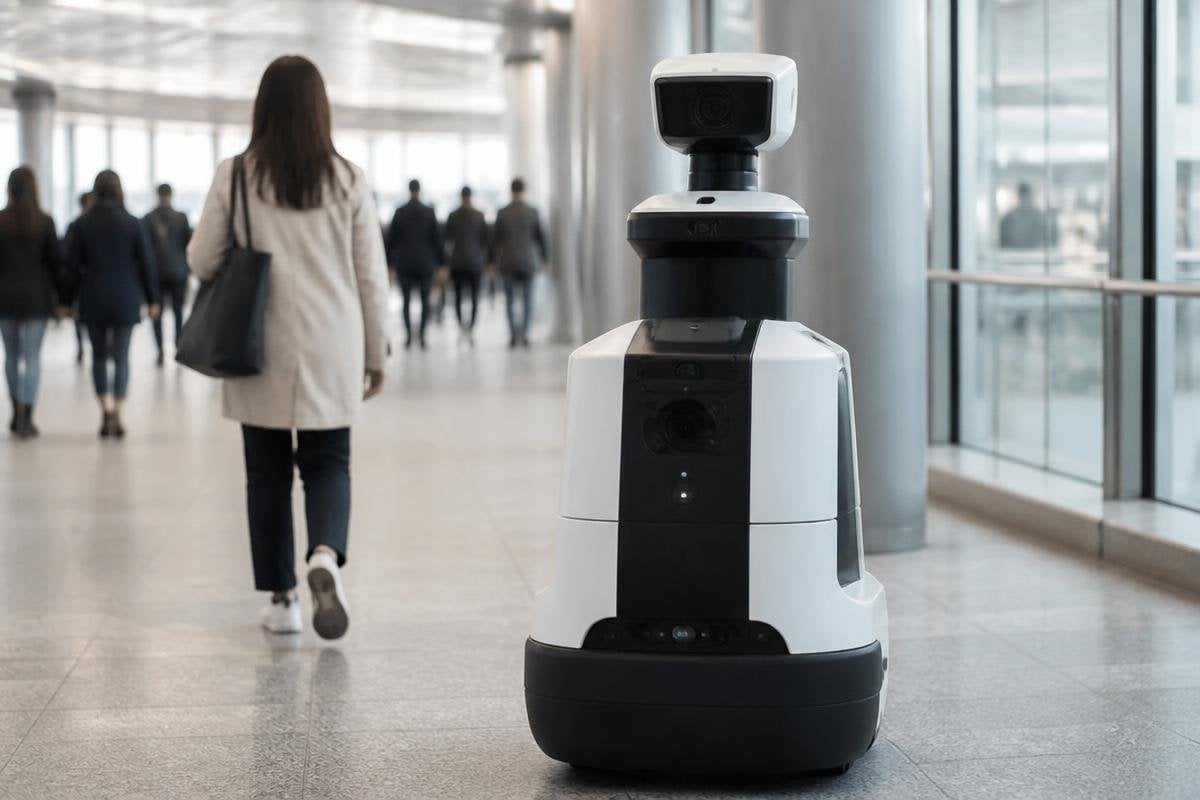
A robot with a camera can identify a face in a station, hospital, or shopping centre. That turns a mobile machine into a tool for watching people who never agreed to be scanned. I’d allow facial recognition robots in public only for a named purpose, under a warrant, and with a human checking every serious result.
Quick read
- Public use needs a clear legal reason, not a vague safety claim
- A short data-retention limit reduces the harm from false matches
- Human review must come before a person is stopped, searched, or denied entry
Why a moving robot changes the question
A fixed camera watches one area. A robot can move between areas, change its viewing angle, and send images through a network while it patrols. The machine may also approach a person, speak to them, or follow them, which gives a face match a direct effect on daily life.
Facial recognition also turns an ordinary image into an identity claim. A camera may record that someone passed a doorway. Recognition software tries to connect that face to a name or profile. The second step needs a separate legal test because the result can affect a person who has done nothing wrong.
A public agency should state the exact job before it buys the robot. Finding a missing child is a narrow task. Scanning every visitor to build a list of people who entered a public place is a different task, even if the same camera can do both.
The rules a public pilot should meet
Permission should start with the purpose, not the hardware. A public body asking to use facial recognition should publish these details before the first test:
- Named target: the system may search for one person or a defined group tied to a specific case
- Legal order: a court or another independent authority approves the search
- Short clock: the trial ends within 30 days unless a new review permits more time
- Limited records: images and match results are deleted within 24 hours when they produce no action
- Human decision: two trained staff members check the evidence before police, security, or staff act
These limits would also give the public something concrete to inspect. A report could show how many faces the robot scanned, how many alerts it made, how many were false, and how long the records stayed on the system.
A scan count means little if the public can’t see how the robot chose a match or what happened after an alert. Reports from Robot 24 can place those choices beside trial results, so the next step is to examine where the system can fail.
Where the system can fail
A face match is not proof of identity. The robot may see a side angle, a covered face, poor lighting, or a person moving through a crowd. A system can also return a match when the correct answer is that no match is reliable.
That failure becomes serious when staff treat the software result as a command. A false alert at a private building may cause embarrassment. A false alert at a transport hub or public event may lead to questioning, removal, or arrest. The policy must treat the alert as a lead for review, never as the final answer.
The robot should also show a clear sign when facial recognition is active. People need to know when the system is scanning, who controls the data, and how to challenge a result. A notice hidden in a long privacy document does not give a person a useful choice at the moment of scanning.
When permission should stop
Some uses should not pass a public review. A robot should not scan everyone to find people with an unknown future risk. It should not identify people at a protest, track a person across several public sites, or keep a face record for later searches without a separate legal order.
The same restriction should apply when a private company runs the robot on public land. Changing the owner does not change the effect on the person being scanned. Public access requires public rules.
A decision guide for officials
Before approving a system, ask:
- What exact event or person is the robot meant to identify?
- Who grants permission, and can that body reject the request?
- What happens after a match, before any person is approached?
- How many hours can images and results remain stored?
- Can an affected person see the record and challenge the decision?
- Who pays for an error, and who reports it?
If an agency can’t answer those questions in plain language, the robot isn’t ready for public use. The next sensible test is a small, public trial with a 30-day end date, published error figures, and no action based on software alone.
